Set a metronome to 135, about what BPM sites list for John Coltrane’s “Blue Train,” and start the record. On the upload we measured, the band is at about 150 when Coltrane’s solo starts. About nine minutes in, it’s down to 134.7.
So do classic jazz records speed up? We measured jazz tempo drift on 32 famous recordings from 1945 to 1977, using two independent methods, and kept the 22 where both methods agreed.
Quick answer
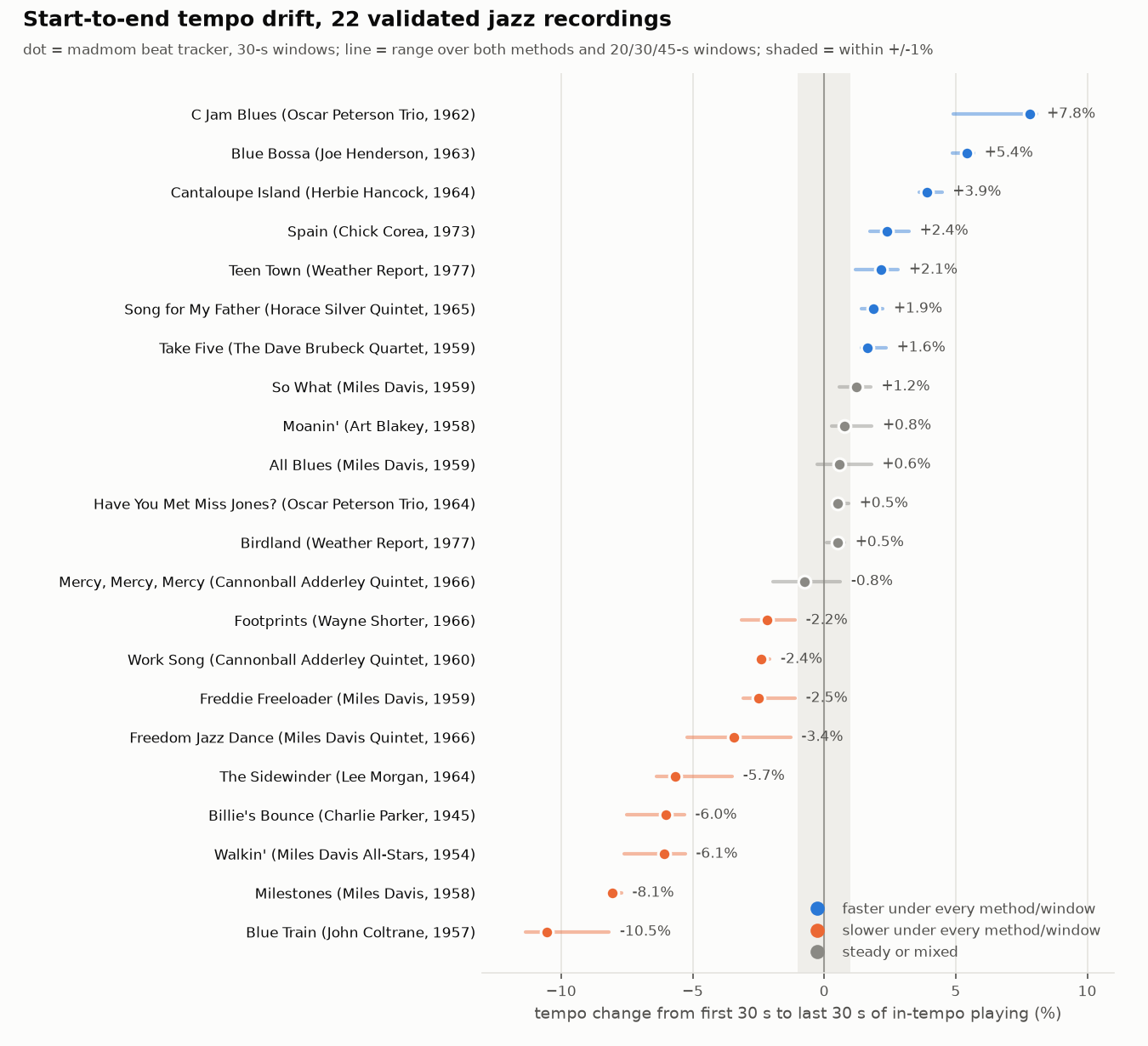
Do jazz records speed up? On the records we tested, not reliably: of the 22 we could measure with confidence, 7 got faster, 9 got slower and 6 stayed steady or were too close to call. The median start-to-end change was 2.4%. The middle moved more: typically about 7% between the slowest and fastest 8 bars.
How we measured
We measured only the in-tempo playing on official uploads, leaving out rubato intros, fades and codas. Start tempo is the median of the first 30 seconds of that playing, end tempo is the median of the last 30, and drift is the percent change.
- Two methods. A neural-network beat tracker finds every beat, and a separate method measures the average pulse without finding beats. A record only counts if they agree.
- Checks by hand. On four records, our hand counts came within 0.52% of the tracker, and on 8 solos our tempos landed within 0.74% of the Weimar Jazz Database, where the beats were marked by hand.
- The right pulse. We counted the quarter note, even on fast tunes where BPM sites count every other beat and list half that.
Details are in Method and limits at the bottom.
Which records sped up most?
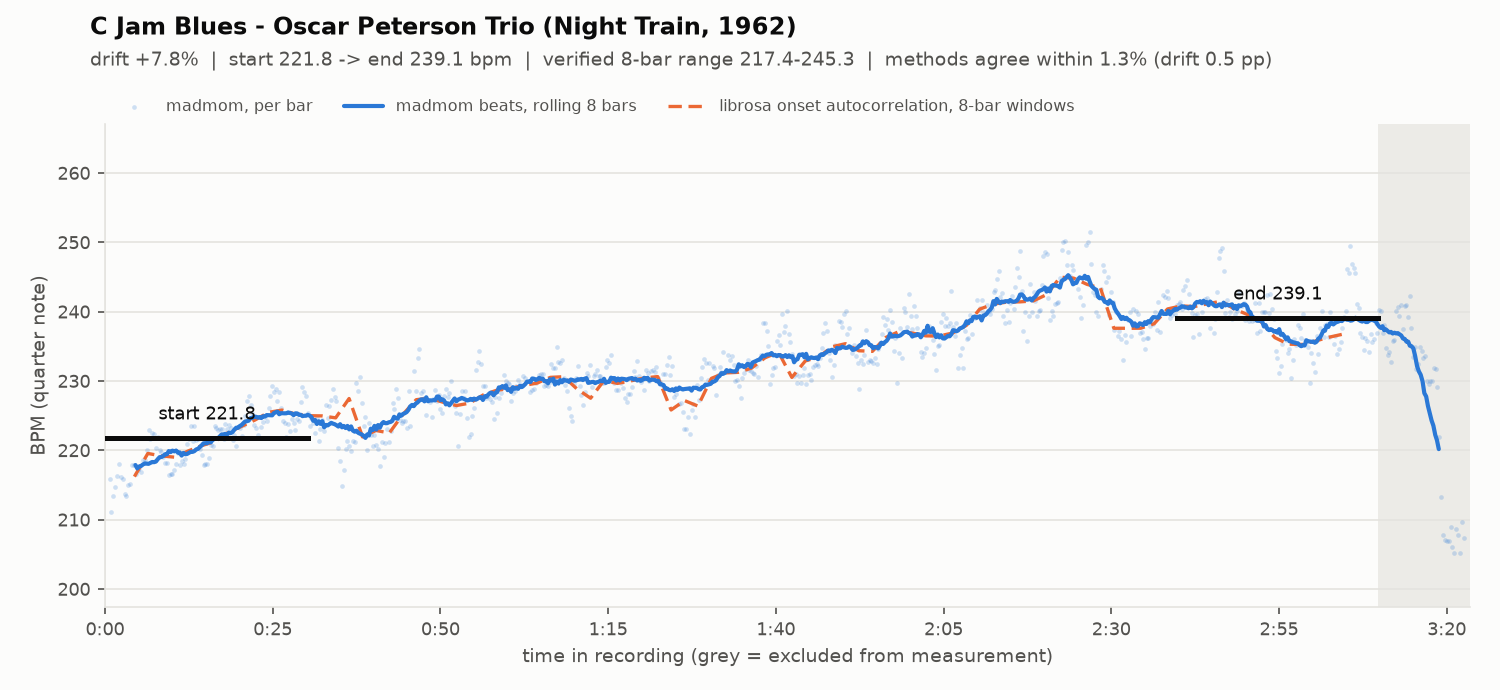
Seven records passed our strict test for “faster,” which means drift above +1% under both methods and three window lengths. The Oscar Peterson Trio’s “C Jam Blues,” from Night Train, climbed the most: 7.8%, from about 222 bpm to about 239 on our upload. Our hand counts found 219.2 near the start and 239.3 near the end.
Next came “Blue Bossa” from Joe Henderson’s Page One (5.4%), Herbie Hancock’s “Cantaloupe Island” (3.9%), Chick Corea’s “Spain” (2.4%) and Weather Report’s “Teen Town” (2.1%). If you’re learning the Spain bass transcription or Teen Town on upright, the end of the record runs a little quicker than the start. Horace Silver’s “Song for My Father” (1.9%) and the Dave Brubeck Quartet’s “Take Five” (1.6%) make seven.
Several of these, like “Blue Bossa,” “Cantaloupe Island,” “Spain” and “Teen Town,” have a straight feel rather than swing. We noticed that afterward and didn’t test it, and 22 records is far too few to say anything about style. It’s a question for a future study.
Which records slowed down?
Nine records passed the strict test for “slower.” The biggest change in the set is “Blue Train”: 10.5% slower, from 150.5 to 134.7 bpm on our upload. The opening head is played over sustained hits, not a steady beat, so our start window begins with Coltrane’s first solo chorus. Across window lengths and methods, the drop measures 8.2% to 11.4%.
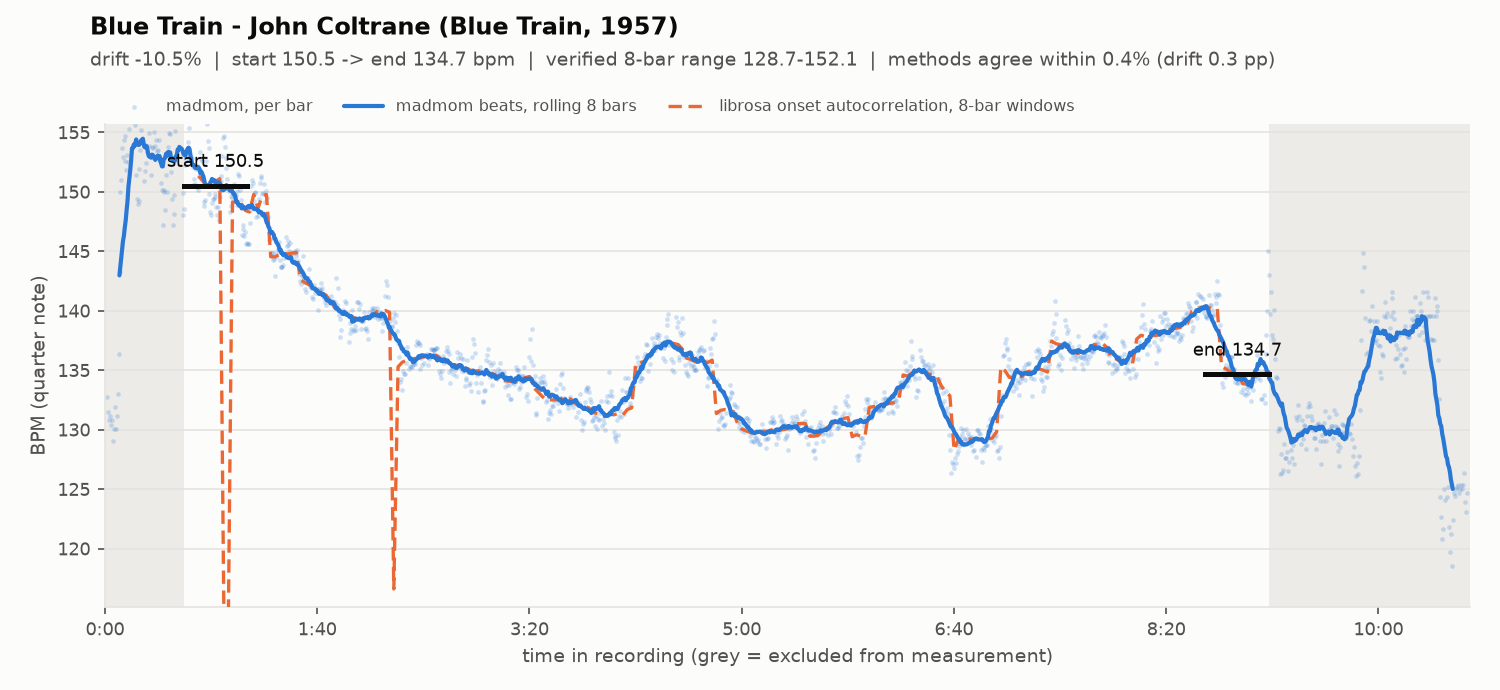
The Weimar Jazz Database backs this up. Its tempos for the three solos, from hand-marked beats, are 141.4 for Coltrane, 133.6 for Lee Morgan and 131.8 for Curtis Fuller. Ours over the same stretches are 141.3, 133.4 and 131.1.
Miles Davis’s “Milestones” slid 8.1%, from about 250 to about 230 on our upload, and every window and method puts it between 7.7% and 8.3% slower. Hand counts of 250.3 and 229.7 agree.
Next are “Walkin’” by the Miles Davis All-Stars (6.1%), Charlie Parker’s “Billie’s Bounce” (6.0%), whose head has its own fingering lesson here, and Lee Morgan’s “The Sidewinder” (5.7%). “Freedom Jazz Dance,” “Work Song,” “Footprints” and “Freddie Freeloader” each ended 2.2% to 3.4% slower. That’s the Kind of Blue track where Paul Chambers plays triplet fills.
Across the 22, there’s no overall lean. By raw numbers, 12 records ended faster and 10 ended slower, and the median drift is +0.5%.
Which records stayed steadiest?
Two records passed the strict test for “steady,” staying within 1% under every method and window: the Oscar Peterson Trio’s “Have You Met Miss Jones?” and Weather Report’s “Birdland,” both +0.5%. We also compared each record’s fastest 8-bar stretch with its slowest, and the narrowest gaps were “Birdland” (3.4%), “Song for My Father” (3.6%), “Teen Town” (3.8%), “Have You Met Miss Jones?” (4.7%) and “Freddie Freeloader” (4.7%).
“Miss Jones” is the record Cole Davis uses in his lesson on Ray Brown and time vs feel, where a tempo tracker shows the number changing every beat, 76 to 81 to 74, and the line still swings. On our upload, its 8-bar tempo stays between 79.3 and 83.0 bpm, with +0.5% from start to end. Both are true: beat to beat the time pushes and pulls, and over 8 bars those moves mostly cancel out.
What happens in the middle of a tune?
The median gap between a record’s fastest and slowest 8-bar stretch was 7.1%, from 3.4% on “Birdland” to 18.2% on “Blue Train.” On all 22 records, that gap was bigger than the start-to-end drift.
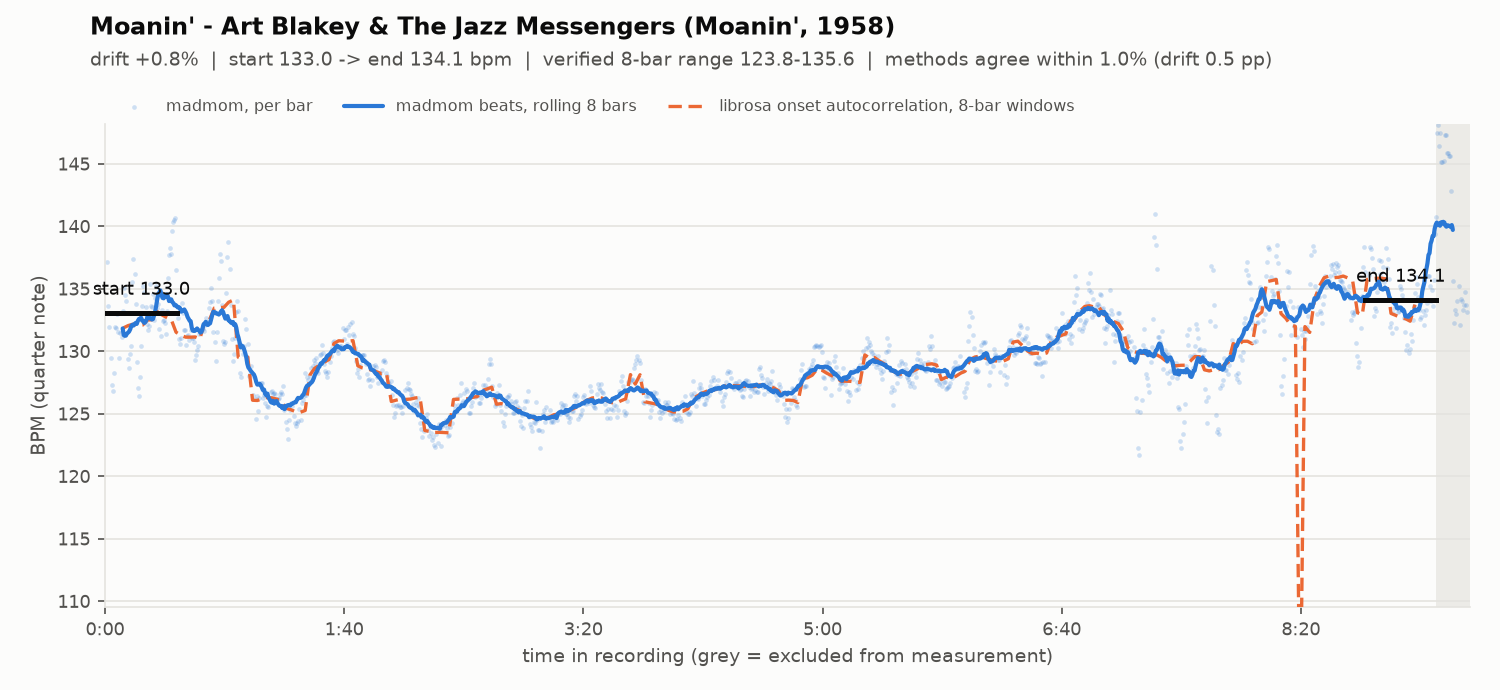
On our upload, “Moanin’” by Art Blakey and the Jazz Messengers starts at 133.0 bpm and ends at 134.1, just 0.8% apart. In between, the tempo sags during the solos to 123.8 around 2:20, about 7% below the start, then climbs back for the out-head.
Some changes show up between solos. On “So What,” the tempo during Coltrane’s solo averaged 2.1% faster than during Miles Davis’s solo before it, and the Weimar data shows 2.2%. That’s worth knowing if you’re playing along to learn the So What bass line.
Do BPM sites list fast jazz at half tempo?
Sometimes. On our three fastest records, the songbpm.com listings are about half of what we measured: “Milestones” at 117 (we measured about 250 falling to 230), “C Jam Blues” at 115 (about 222 rising to 239) and “Freedom Jazz Dance” at 100 (about 202 easing to 195).
Those listings are Spotify-derived, so software picked the pulse, and fast swing offers two believable ones: the walking bass and ride cymbal on every beat, or the hi-hat on 2 and 4. Given a free choice from 50 to 320 bpm, our own tracker also picked half time on all three, and double time on “Teen Town.” So we pinned each record’s pulse and checked it against the ride cymbal and bass or, where those couldn’t settle it, against published listings.
Most listings are fine: 18 of our 22 records match at least one published figure. “Blue Bossa,” listed at 82, is just counted in half notes, which is a notation choice. And “Have You Met Miss Jones?” is listed at 81, close to our hand counts of 82.0 and 82.6. The practical rule: if a listed tempo feels half as fast as the record, double it.
Results for all 22 records
| Track | Artist | Year | Start (bpm) | End (bpm) | Drift |
|---|---|---|---|---|---|
| C Jam Blues | Oscar Peterson Trio | 1962 | 221.8 | 239.1 | +7.8% |
| Blue Bossa | Joe Henderson | 1963 | 159.0 | 167.6 | +5.4% |
| Cantaloupe Island | Herbie Hancock | 1964 | 112.1 | 116.5 | +3.9% |
| Spain | Chick Corea & Return to Forever | 1973 | 135.1 | 138.4 | +2.4% |
| Teen Town | Weather Report | 1977 | 126.4 | 129.1 | +2.1% |
| Song for My Father | Horace Silver Quintet | 1965 | 127.0 | 129.4 | +1.9% |
| Take Five | The Dave Brubeck Quartet | 1959 | 169.0 | 171.8 | +1.6% |
| So What | Miles Davis | 1959 | 134.6 | 136.3 | +1.2% |
| Moanin’ | Art Blakey & The Jazz Messengers | 1958 | 133.0 | 134.1 | +0.8% |
| All Blues | Miles Davis | 1959 | 138.1 | 138.9 | +0.6% |
| Have You Met Miss Jones? | Oscar Peterson Trio | 1964 | 81.0 | 81.4 | +0.5% |
| Birdland | Weather Report | 1977 | 157.6 | 158.4 | +0.5% |
| Mercy, Mercy, Mercy | Cannonball Adderley Quintet | 1966 | 170.4 | 169.1 | -0.8% |
| Footprints | Wayne Shorter | 1966 | 137.2 | 134.2 | -2.2% |
| Work Song | Cannonball Adderley Quintet | 1960 | 170.5 | 166.4 | -2.4% |
| Freddie Freeloader | Miles Davis | 1959 | 130.0 | 126.7 | -2.5% |
| Freedom Jazz Dance | Miles Davis Quintet | 1966 | 202.1 | 195.2 | -3.4% |
| The Sidewinder | Lee Morgan | 1964 | 161.5 | 152.3 | -5.7% |
| Billie’s Bounce | Charlie Parker | 1945 | 165.3 | 155.3 | -6.0% |
| Walkin’ | Miles Davis All-Stars | 1954 | 131.2 | 123.2 | -6.1% |
| Milestones | Miles Davis | 1958 | 249.6 | 229.5 | -8.1% |
| Blue Train | John Coltrane | 1957 | 150.5 | 134.7 | -10.5% |
What this means for your playing
On these records, the start-to-end change is often small: 12 of the 22 ended within 2.4% of where they started, though 7 moved more than 5%. The middle moves more: about 7% between the slowest and fastest 8 bars on a typical record, and even “Birdland” moved 3.4%. A click doesn’t move at all.
So practice with records, not just a metronome. That’s the advice in Cole Davis’s Miss Jones lesson: a metronome helps you get in the ballpark, but you work on feel by playing along to records.
Your bread and butter as a bass player is making everything feel good.
Cole Davis
- Use the click for the ballpark. Set it from the opening of the record, not from a website, and double a listed number that feels half as fast.
- Then play along with the record. For the swing tunes, our guide to walking bass lines covers what to play.
- Check the tempo where you are. On our upload of “Milestones,” the last 30 seconds run about 20 bpm slower than the first 30.
The data can’t tell you whether these changes were planned or whether they help a record. It only shows how much these records move.
Pick one record from the table tonight and see if you can stay with the band from the first chorus to the last.
FAQ
Do jazz records get faster as they go?
Some do and some don’t. Of the 22 records we could measure reliably, 7 ended clearly faster, 9 clearly slower and 6 were steady or too close to call. The Oscar Peterson Trio’s “C Jam Blues” climbed 7.8% and John Coltrane’s “Blue Train” dropped 10.5%, but across the set there’s no overall lean.
What’s tempo drift?
It’s the change between a record’s tempo at the start and at the end. We compared the median tempo of the first and last 30 seconds of in-tempo playing. A drift of +2% on a tune that starts at 150 bpm means it ends around 153.
Should I practice with a metronome or with records?
Both, for different jobs. As Cole Davis says in his Miss Jones lesson, a metronome helps you get in the ballpark, but you work on feel by playing along to records. Every one of the 22 records in our results moved at least 3% between its slowest and fastest 8 bars. A click never moves.
Does pressing speed change these results?
It changes the bpm, not the drift. Releases of the same master can differ in speed by a couple of percent, so our bpm figures describe the uploads we measured. Drift is a percentage of each record’s own starting tempo, so a constant speed difference cancels out of it.
Method and limits
- Audio and region. We used official uploads only, each checked for the right album and recording. Measuring runs from the first 8 steady, clearly beated bars to the last 8, under rules fixed in a 7-record pilot and applied automatically.
- Two methods. Method A is the madmom neural-network beat tracker. Method B is librosa onset autocorrelation, which measures average periodicity and shares no code with A. Both are held to a band around each record’s pulse, so neither can jump to half or double time. On synthetic swing audio with known tempo curves, both were accurate to about 0.1% in tempo and 0.2 points in drift.
- Validation. A record passes if its pulse level checks out and the methods agree within 3% on start and end tempo, within 1 point on drift, and within 3% on the 8-bar curve for at least 90% of the track. A direction label has to hold under both methods with 20-, 30- and 45-second windows. Anything else is “mixed”: “So What,” “Moanin’,” “All Blues” and “Mercy, Mercy, Mercy.”
- Excluded records. Ten were excluded because the measurement methods disagreed: “Giant Steps,” “Mr. P.C.,” “Autumn Leaves,” “Acknowledgement” from A Love Supreme, “Watermelon Man,” “Maiden Voyage,” “Chameleon,” “St. Thomas,” “Oleo” and the title track of Night Train. “Walkin’” and “Freedom Jazz Dance” only just passed.
- Checks. Hand counts on “Milestones,” “C Jam Blues,” “Blue Train” and “Miss Jones,” made from plots of note onsets with no tracker output shown, matched the tracker’s beat count every time and its tempo within 0.52%. Against the Weimar Jazz Database from the Jazzomat Research Project, whose tempos come from hand-marked beats, our averages for 8 solos on “Blue Train,” “Walkin’,” “The Sidewinder” and “Footprints” landed within 0.74% of theirs. Charlie Parker’s solo on “Billie’s Bounce” came within 0.81%, though the database doesn’t say which take it used. Its “Work Song” solos come from a different take, so we didn’t use them. Thanks to the Jazzomat team for making it public.
- Pressing speed. Our “So What” reads about 2% below the Weimar figures for all three solos, by nearly the same ratio, and their data comes from an older CBS CD. That points to a speed difference between releases, which shifts the bpm, not the drift.
- Limits. These 32 records were picked because they’re famous, not at random, so the results describe them, not jazz in general. There are too few fusion and funk tracks to compare styles, and 8-bar averages hide the bar-to-bar push and pull.
Go deeper
The Locked-In Bassist: Swing With Any Drummer
How to lock in with any drummer who counts it off, even the ones who rush, drag and throw fills at you.