Gift guide
Shopping for a bass player when you don't play yourself? Start here. Everything on this page is a course or lesson from Better Bass Lessons, taught by Cole Davis, a New York jazz bassist who studied with Ron Carter at Juilliard, or by one of the working players he's brought in. We've sorted it by who you're buying for and explained the bass words along the way. Most of these assume the bassist can already play a little, so each one says who it's for.
Send a gift card
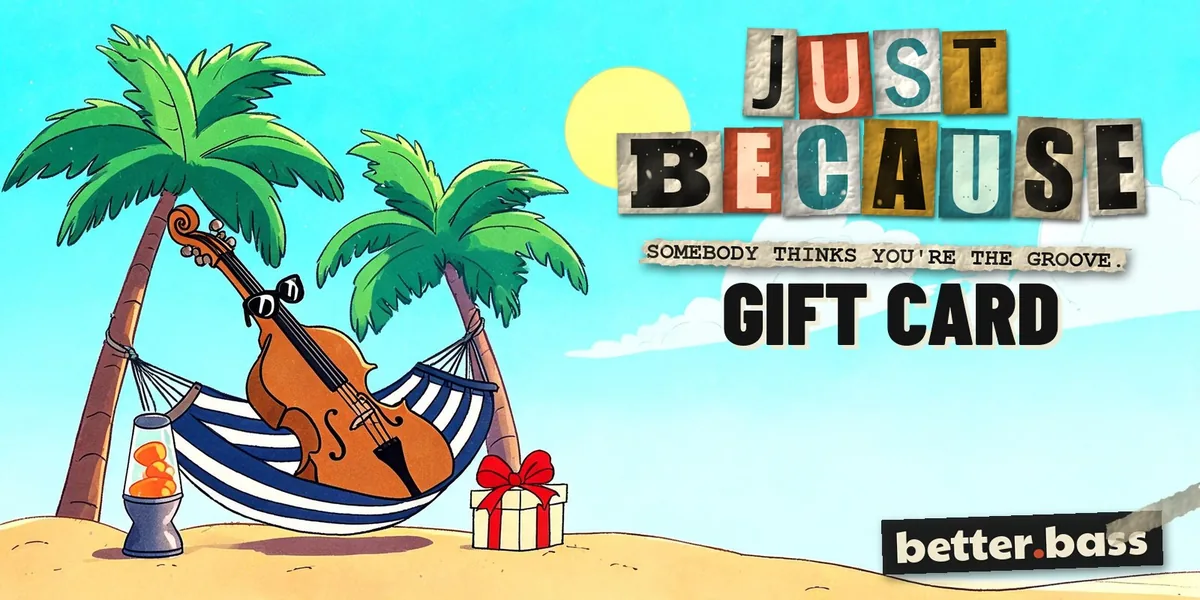
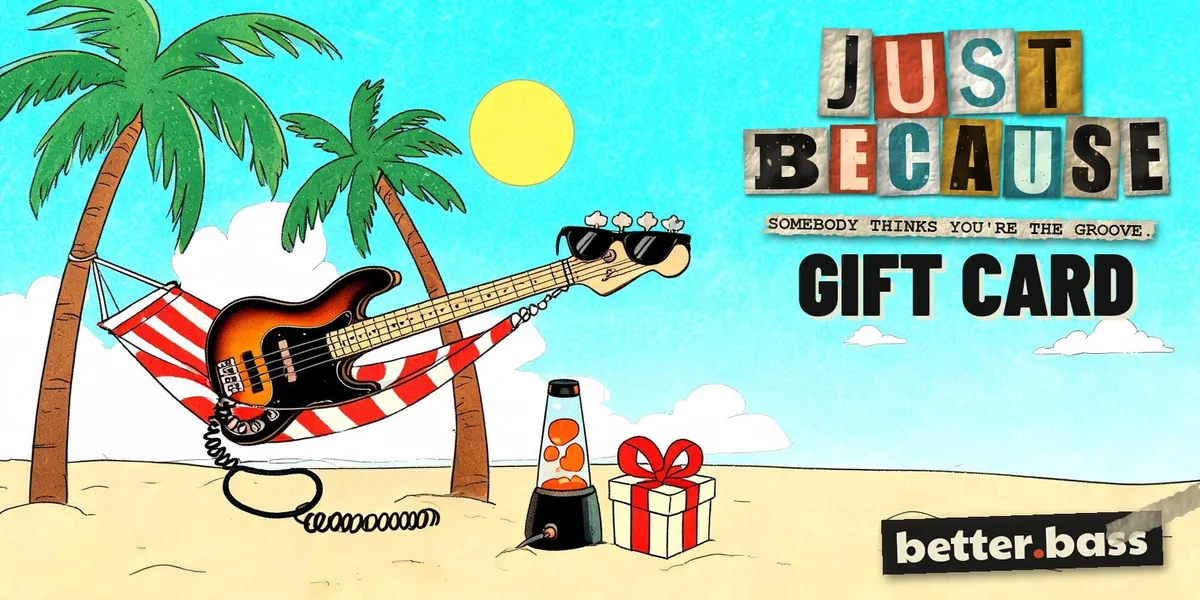
Not sure which course they’d pick? Send a gift card and let them choose. Each design comes with an upright bass or an electric one, but that’s just the picture: every card works on any course, upright or electric. It arrives by email on the day you pick and never expires.
Upright bass designs




Electric bass designs




How the gift card works
- 1Pick a design above and tap Send this card.
- 2Pick an amount on the next page.
- 3Choose "Someone Else," then type their name and email.
- 4Pick the day it arrives and add a note.
- 5They get the card by email with a code to use at checkout on betterbasslessons.com. It's good for any course, upright or electric, and it never expires.
Which bass do they play?
Upright bass
Also called a double bass. It’s the big wooden one, about as tall as a person, played standing up or perched on a stool.
Electric bass
It looks like a guitar with a longer neck, hangs from a strap and plugs into an amp.
Not sure which one they play? Pick something marked Upright or electric or Any instrument, or send a gift card.
For a bassist just starting jazz
Most of a jazz bassist's night is spent playing a walking line: one note on every beat, stepping from chord to chord under the band. These start right there, with one walking course for each kind of bass and an ear-training course that works on any instrument.
Five lessons
UprightWalking Basslines on Upright Bass: From the Beginning
Five upright lessons that build walking lines from the four basic notes of each chord, the approach Ron Carter taught Cole at Juilliard, from an F blues up to Autumn Leaves. Every line comes written out, with backing tracks, for players who can already keep time and read a basic chord chart.
Eleven lessons
ElectricThe 7-Day Walking Bass Breakthrough
Eleven video lessons laid out as a seven-day plan for electric bassists who want to walk through any jazz tune, ending on a full chorus of Green Dolphin Street. It comes with lead sheets, backing tracks and Cole's 40-page Ray Brown analysis, for players who can read a basic chord chart.
Six lessons
Any instrumentPlay What You Hear
Six lessons on learning songs by ear, on any instrument and at any level: sing it, find it on the piano, then play it, worked through on the Beatles' Yesterday and Bill Withers' Ain't No Sunshine. They won't need to read music or have perfect pitch, just a piano or a keyboard app to check themselves.
For an upright player
For the bassist with the big wooden bass. Every one of these is taught on upright, and each note says how far along they should be.
Five lessons
UprightJazz Soloing on Upright Bass: From the Beginning
For the upright player who can walk a line but freezes when the bandleader points at them for a solo. Five lessons turn the bass line they already play into a solo step by step, with practice videos, PDFs and backing tracks.
Video and 37-page book
UprightWalk Like Ray Brown
Ray Brown played bass with the Oscar Peterson Trio, and Cole sums up how he organized his walking lines in a two-line formula, taught in a 31-minute video on upright and a 37-page book with five of Brown's lines written out note for note. It's for upright players who can already walk through a blues in time.
15 exercises
UprightThe New Simandl
Most upright players learn from Franz Simandl's method book, written in the 1800s for orchestra players; Cole's rewrite gives 15 of its exercises new fingerings built around the open strings so the left hand moves freely around the bass. Each exercise has a video and a backing track, for upright players (or electric players moving to upright) who read music.
11 exercises
UprightThe 15 Minute Warmup: Upright Edition
The 11-exercise warmup Cole runs before every gig with Peter Cincotti, with Simandl fingerings printed on every page and backing tracks with and without bass. It's built for players with at least a year on upright who read bass clef, and the exercises are plucked, not bowed.
Four lessons
UprightBebop for Bass: The Paul Chambers Approach
Four video lessons on soloing in the bebop style through twelve licks (short signature phrases) from Paul Chambers, the bassist who worked out how to say Charlie Parker's language on the upright, with every lick written out with fingerings in all 12 keys. It's for intermediate upright players who know their major and minor triads.
For an electric player who wants to play jazz
Jazz isn't only for the upright. These are taught on electric bass, for players who can already hold a groove and want to take a solo, their turn in the spotlight while the band keeps playing. If they've never played jazz at all, start with The 7-Day Walking Bass Breakthrough above.
Five lessons
ElectricJazz Soloing on Electric Bass: From the Beginning
Cole's soloing method on electric bass: five lessons that start from the walking line they already play and chisel it into a solo, with no scales or modes to memorize. Each lesson has a practice video, a PDF in tab and notation and backing tracks, for players who can already walk a line through a blues.
25 lessons
ElectricThe Diagonal Method
About two and a half hours of electric bass video in 25 lessons from Anthony Muthurajah, who's performed with The Brand New Heavies and The Supremes, on soloing by moving across the strings and along the neck at the same time. It's for intermediate players who can hold the time but freeze when it's their turn to solo.
Ten warmups
ElectricThe 15 Minute Warmup: Electric Edition
Ten electric bass warmups, each a written line plus a chord to improvise on, built so the first tune of a gig sounds as good as the fifth, with backing tracks with and without bass. It's for players with at least a year on electric who know basic notation.
For the one who plays in a band
For the bassist who plays with a drummer, a band or a weekly jam. These are about what happens when other people are in the room: timing, feel, listening and getting called back.
Bass and drums
Upright or electricThe Locked-In Bassist: Swing With Any Drummer
Cole on bass and drummer Aaron Seeber, filmed in the studio, on holding steady time when a real drummer rushes, drags or throws a fill across the bar line, explained from both chairs. It works on upright or electric, for players who can already walk a chorus of blues.
Sixteen lessons
Upright or electricThe Five-Feel Groove System
Sixteen lessons from Paul "Papa Bear" Johnson, who plays bass for Taylor Swift, Lizzo and Leon Bridges and on Broadway in Aladdin and Hadestown, on where to place each note against the beat: on it, behind it, ahead of it, straight or swung. It works on electric or upright in any style, for players past their first bass line.
Live masterclass
UprightFrom Two to Four: Walk Any Jazz Gig With Confidence
A live masterclass with New York bassist Alex Claffy, filmed with pianist Victor Gould and drummer Joe Strasser, on how a jazz rhythm section (bass, piano and drums) listens and signals to each other on the bandstand. Alex plays upright throughout, and it's for intermediate players who can already walk through a blues.
Eight modules
Any bassistFrom Unknown to Unavailable
New York bassist Will Lyle's field manual for bassists who can play but aren't getting called for gigs: eight video modules on jam sessions, relationships and how working players get hired, plus a workshop replay and his jazz standards list. The stories happen in New York, but the playbook is about how calls happen in any scene and any genre.
For the one who loves the old records
A transcription is a bass part or solo written out note for note from a famous recording. Each of these pairs one classic jazz record with a video lesson from Cole and the bass part written out as a PDF. If one of these albums lives on their shelf, start there.
From Kind of Blue
Paul Chambers: Freddie Freeloader
Kind of Blue is famous for its simplicity, yet on Freddie Freeloader Paul Chambers plays what Cole calls the busiest B-flat blues line he's ever heard. A 6-minute video breaks down why it works, and the full bass line comes as a PDF.
From A Love Supreme
Jimmy Garrison: Resolution from A Love Supreme
On Resolution, from A Love Supreme, Jimmy Garrison opens with an unaccompanied bass intro built on fourths. Cole's 10-minute lesson shows how to play it, and the full transcription comes as a PDF with fingerings.
With Ahmad Jamal
Israel Crosby: But Not for Me
Israel Crosby's line on But Not for Me, with Ahmad Jamal, is the one Cole considers the greatest jazz bass line ever played, and the one his whole way of teaching walking bass came out of. It's a 10-minute video lesson with the bass line written out as a PDF.
From Red Clay
Ron Carter: The Intrepid Fox
Ron Carter's opening line on Freddie Hubbard's The Intrepid Fox, from Red Clay, is one note per beat over a single chord, and it still sounds like a composition. Cole, who's taken lessons with Carter, breaks down the two-bar phrases behind it in a 17-minute video, with the bass line as a PDF.
From You Must Believe in Spring
UprightEddie Gomez: You Must Believe in Spring
Cole considers Eddie Gomez's solo on the Bill Evans Trio album You Must Believe in Spring the greatest upright bass solo of all time, and he talked it over with Gomez himself in 2014. The 17-minute lesson comes with the solo transcription and the thumb position exercise (for playing high up the neck) Gomez showed him, both as PDFs.
Small gifts
Single lessons and short packets that make easy add-ons or stocking stuffers. A few of them come from outside jazz: Stevie Wonder, Simon & Garfunkel, Cat Stevens and Nick Drake.
3-minute lesson
Ron Carter x Black Sheep: The Choice Is Yours
The bass line from Black Sheep's The Choice Is Yours, which Cole grew up hearing in car commercials and sports broadcasts. A 3-minute video shows where the sample came from and how to play it, and the line comes written out with tab (a simple chart of strings and fret numbers).
12-minute lesson
UprightStevie Wonder: Lately
The upright bass sound on Stevie Wonder's Lately is really a synth, so the line was never built for a bass player's hands. Cole wrote it out for a real upright, simplified it, added fingerings and walks through it in a 12-minute video.
8-minute lesson
UprightFolk on Upright: Nick Drake, Simon & Garfunkel, Cat Stevens
Three folk records with some of Cole's favorite upright playing: Danny Thompson on Nick Drake's Man in a Shed, Bill Lee with Simon & Garfunkel on Wednesday Morning, 3 A.M., and John Ryan on Cat Stevens' Wild World. It's an 8-minute video lesson with the full transcription as a PDF.
Play-through and PDF
John Coltrane: Giant Steps Solo (with Tab)
Coltrane's solo on Giant Steps, written out for bass with tab under the notes and chord symbols over every bar. It comes with a short play-through on electric bass with the music on screen.
14-page PDF
UprightScales and Arpeggios
The scales and arpeggios Cole warms up with every day, written out for upright with fingerings that use the open strings so there's no shifting. It's a 14-page PDF with no video, for upright players who read bass clef.
FAQ
Does the design have to match the bass they play?
No. The bass on the card is just the picture. Every card works on any course, upright or electric.
Do Better Bass Lessons gift cards expire?
No. The card never expires. They use its code at checkout on betterbasslessons.com.
How does the gift card reach them?
On the card's page, choose "Someone Else," then type their name and email, pick the day it arrives and add a message. They get the card by email with a code to use at checkout.
What if I don't know which bass they play?
Pick something marked "upright or electric" or "any instrument," or send a gift card so they can choose.